
Inquiries, partnerships, and case study downloads:example@robotlyne.com
Robotic Screw Fastening Cell for Notebook Keyboards
An inline robotic screw fastening solution for notebook keyboards, designed around 120 UPH throughput, sub-26-second cycle time and digital torque traceability.
See how we designed this project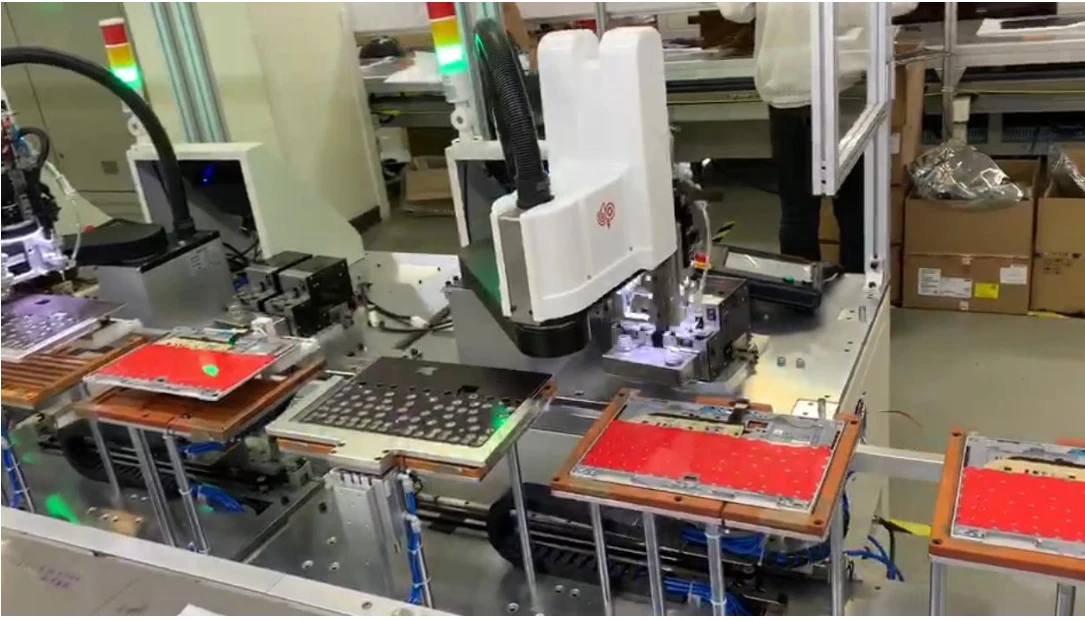
Project Snapshot
- Client Type
- Notebook Keyboard Manufacturer
- Timeline
- Not specified in source proposal
- Deliverables
- Five-station inline fastening plan
- Vision-guided screw fastening robot
- Transfer and product fixture mechanism
- Digital tightening monitoring software
Background
The source proposal describes a notebook keyboard assembly process that needed inline robotic screw fastening for 14-inch and 16-inch products. Each keyboard required 42 M1.2 x 1.5 screws with a torque range of 0.1 to 2.0 +/- 0.05 kgf.cm.
The line target was 120 UPH, a cycle time within 26 seconds, 99.8% fastening yield and 0.2 mm floating-height control according to screw length.
Challenge
The customer needed to fasten 42 M1.2 screws per notebook keyboard while keeping an inline equipment layout and maintaining product compatibility across 14-inch and 16-inch variants.
The process also needed torque control, screw-by-screw result traceability and enough cycle-time margin to stay within the 26-second CT target.
Approach
- Planned five inline fastening cells, with each cell responsible for 9 screws. The proposal estimates 6 seconds for transfer, 1.5 seconds for imaging and 18 seconds for fastening, for a total of 25.5 seconds.
- Designed the fastening sequence around product arrival detection, cover pressing, two vision capture positions, screw pickup and screw fastening before releasing the product to the next station.
- Integrated a screw feeding system, transfer mechanism, product fixture and press-cover mechanism around the robotic fastening station.
- Used an intelligent electric screwdriver module with vision positioning, displacement sensing, vacuum pickup, +/- 5% torque accuracy and torque-curve recording.
- Included production monitoring software to display tightening results, analyze NG data and show torque, turns and fastening status for each screw.
Outcome
The proposed cell replaces repetitive manual screw fastening with a controlled robotic process while keeping the line inline and digitally traceable.
The solution is designed to improve productivity, reduce operator load and give production teams adjustable fastening parameters, screw-level process data and clearer quality consistency across notebook keyboard assembly.
Project Feedback
Share a short review of this case study or tell us what kind of automation project you want to compare it with.
No published reviews yet.